Saturday, April 28, 2007

Europe as it was?


Is this something what old Greece might have looked like? Reportedly, the countryside was thickly timbered before population increases led to deforestation. Cedars and pines crawled down to the water's edge, where you could see wild beasts (lions, bears, wolves) cool themselves by the water. Eagles perched on the tops of the tallest trees and gulls and cormorants foraged for fish and scraps. Dolphins and porpoises played in a trireme's wake, and dogs on board the ship barked at other dogs on shore.

If old novels are to be believed, forests like these hid ruthless bandits carrying heavy iron weapons. The secluded cove around the corner might have harboured pirate ships lying in wait for merchants or easy victims.

Tuesday, April 24, 2007

Dinner Parties


After dinner but before the party (symposion) began, a die was cast to decide who would be the 'King of the Feast'. He decided 1) what ratio water to wine should be mixed (usually 3:1), 2) what the rules of the party should be, and 3) what the penalties would be if rules were broken.

The wine was mixed in large pots (krateres).

Naked young slaves (male or female) filled cups with wine using ladles (kantharoi) and passed the cups around. First they gave everyone small goblets, then larger ones. Guests had to empty each glass in one go, drinking to the health of his right-hand neighbour.

The guests might watch:
jugglers (male or female)
rope dancers
sword-jumpers
contortionists (eg woman ladling wine using her feet to hold ladle + cup whilst walking on her hands)
rooster fights

Or they might play games:
a board game called 'the game of cities'
games of chance using dice or knucklebones (astralogoi)
a game in which both players open a clenched hand simultaneously at quick speed, and each person has to call out the number of fingers extended by the other.

Or they might perform mimetic dances


(info from The Greeks and Romans: Their Life and Customs by E. Guhl and W. Koner, Bracken Books London, 1989 pages 267-73)

Saturday, April 21, 2007

End of the Minoans


Minoan civilisation may have collapsed thanks to a volcano, tsunami and subsequent climate change! Here's the dirt:

http://www.bbc.co.uk/history/ancient/greeks/minoan_01.shtml

Thursday, April 19, 2007

Temple of Zeus Olympios


In which sat a statue of Zeus...

"Zeus was represented as sitting on a throne...of cedar wood, laid in with ebony and richly adorned with valuable stones and sculptures. The base was also richly decorated in accordance with the figure itself. The face, the chest, the naked upper part of the body, and the feet were of ivory; the eyes consisted of brilliant stones. The waving hair and beard were of solid gold, as was also the figure of Nike [goddess of victory] which the god held in his extended right hand; the sceptre in his other hand was composed of different precious metals. The drapery covering the lower part of the body was also of gold, with flowers in a kind of enamel."

"The height of the statue was 40 feet, almost too colossal, in proportion to the surrounding architecture, so that the Greeks themselves used to say that if the god rose from his seat he would knock the roof overhead."


From The Greeks and Romans: Their Life and Customs by E. Guhl and W. Koner (London, 1989)


"The god sits on a throne, and he is made of gold and ivory. On his head lies a garland which is a copy of olive shoots. In his right hand he carries a Victory, which, like the statue, is of ivory and gold; she wears a ribbon and--on her head--a garland. In the left hand of the god is a scepter, ornamented with every kind of metal, and the bird sitting on the scepter is the eagle. The sandals also of the god are of gold, as is likewise his robe. On the robe are embroidered figures of animals and the flowers of the lily. The throne is adorned with gold and with jewels, to say nothing of ebony and ivory. Upon it are painted figures and wrought images. There are four Victories, represented as dancing women, one at each foot of the throne, and two others at the base of each foot....On the uppermost parts of the throne Pheidias has made, above the head of the image, three Graces on one side and three Seasons on the other.... I know that the height and breadth of the Olympic Zeus have been measured and recorded; but I shall not praise those who made the measurements, for even their records fall far short of the impression made by a sight of the image."

Pausanias, Description of Greece (V.11.1-2, 7, 9)

(This quote is taken from http://penelope.uchicago.edu/~grout/encyclopaedia_romana/greece/hetairai/zeus.html)

Tuesday, April 17, 2007

Temple Trivia


I'm reading about Greek temples. (Saucy!)

The Parthenon is probably the most famous and perfect example of Greek architecture. But how much do you know about it?

Here is a pop quiz that you can surprise a friend with in order to show off how much you know about Greek architecture!

1. Where was the Parthenon situated?

2. To which deity was it dedicated?

3. What were the three kinds of columns found in Greek temples?

a) Corinthian, Ionic and Ephesian
b) Corinthian, Cretan and Ephesian
c) Corinthian, Ionic and Doric

4. What was the scandal on the sandal?

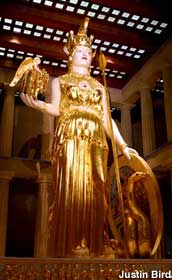
5. Where was a giant statue of Athena kept?

(a) on the steps, where the public could view her
(b) behind the first row of columns, just before the temple entrance
(c) in a walled room inside the temple

6. Who were depicted on the outer edge of Athena's shield?

7. Of what was the Parthenon chiefly constructed?

8. Of what material were Athena's face, neck, hands, arms and feet constructed?

9. What was remarkable about Athena's drapery, aside from the fact that it was made of pure gold?

10. When was the parthenon completed?

ANSWERS

1. In Athens, on the Acropolis.

2. Pallas Athene, primary protector of Athens and the Attic country.

3. (c) Corinthian, Ionic and Doric

4. It is said there were portraits of Phidias (chief sculptor) and Perikles (Athenian statesman) carved on Athena's sandal, which later caused some outrage as this was considered impious.

5. (c)

6. Amazons

7. Pierian marble

8. ivory

9. It was removable

10. 438 BC, by the architects Iktinos and Kallikrates after the Persians destroyed the older Athena temple.


Novel word count: 11, 321

Sunday, April 15, 2007

Assyriana, starring George Clooney


Well not really, but otherwise it might not have that much glamour...at first.

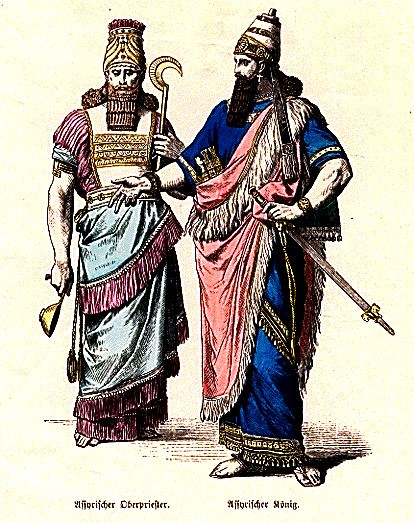
On closer inspection the Assyrians are pretty durned fascinating -- bad-ass, curly-bearded dudes in embroidered dresses.
Assyria, or 'Ashur', as they knew it, incorporated parts of modern Iraq, Syria and Turkey. They were so proud of their unspeakably horrible war crimes that they made huge stone tablets (steles) detailing the inventive tortures (hooking lips, lopping hands and other members....). Not only that, they had a reputation for oppressing women (keep in mind that this was the ANCIENT WORLD, folks! Your man-on-the-street was an opinionated thug who kept his womenfolk locked in a dark room). The king kept a harem of women attended by eunuchs, and all the princes were castrated to keep them from spoiling the regal brood.

But do not think that they were mere thugs! No. For lo, apparently they invented many systems still used today. Locks! Flush toilets! The post! Plus they wore those cool pointy-toed shoes that curl up at the ends. And they crafted some amazing jewellery, like an elaborate golden crown featuring the distinctive winged-bull figure.

A queen's jewellery was found in a tomb, along with a stone tablet inscribed with a curse severely admonishing potential grave-robbers.

They even had their own alphabet and epic, Gilgamesh, which I now desperately want to read. What's more, they have left boastful inscriptions with interesting details such as scorpions and death-penalty procedures.

Yay for the cold-blooded killers! May they rest in peace.

Sunday, April 8, 2007

Ajax

Ajax
by Sophocles.

Scene: (Greek camp outside Troy)

Plot Summary:
One night Ajax is gripped by a psychotic delusion and kills the army's sheep and cows believing them to his hated allies in the Greek army.
The next day he comes to his senses and, despite his wife and half-brother's pleas, he commits suicide in contrition: "Henceforward I shall know to yield to the gods,/And teach myself to respect the Atridae [Menelaus and Agamemnon]".

When his body is found, there ensues a heated argument between Teucer, Ajax's brother, and Agamemnon. Teucer sues for the right to bury Ajax with the proper rites; Agamemnon declares that Ajax should be denied such rites because he tried to kill the Greeks.
In the end Odysseus speaks to Agamemnon as a friend and persuades him to allow the burial to go ahead.

Review:
Antigone has the same kind of plot and is a more interesting play in my opinion.

Wednesday, April 4, 2007

Union Benefits

Here's a poem from a great book, Greek Lyric Poetry trans. Sherod Santos. Norton (2005 NY)

The Tomb of Theris

Here lies a man who made his living off well-
marked traps, who rode the breakers like a gull --

marauder of fishes, hauler of seines, prober
in the crannies of rock and cliff -- who never

once sailed the crowded lanes in an open-
rigged, long-beaked quinquereme, who scorned

the gods by dying not in the bloodbath
of a battle, nor shipwrecked in the aftermath

of a hurricane, nor in any way fishermen
normally end. He died, instead, of his own

accord, dimming out like the evening light
on a cot in his wood-plank hut. No wife,

no children arranged for his burial,
but the members of the local fishermen's guild.

Leonidas of Tarentum


PS Having proper burial arrangements was extremely important to the ancient Greeks, in fact it was one of the main benefits of having children. In Argonautika Jason's mother begs him to stay with her because, "I'd forgotten my troubles/so that you with your own hands might have interred me,/my child; that alone was what I had left to hope for/ from you; with all other returns for nurture I'm surfeited."

Monday, April 2, 2007

Name that Plague!

I've been wondering what diseases afflicted the ancient Greeks, and in particular whether they suffered from smallpox (by the way, if you want to see some truly horrifying examples of that disease, try Google images).*

I know nothing about microbiotic forensics, but this seems a complicated question to answer. I've come across some fairly interesting stuff. For example, this from http://ancienthistory.about.com/od/epidemics/g/Kerameikos.htm:

"Kerameikos [a potter's district in ancient Athens] has an ancient burial pit with bodies from the Peloponnesian War, which Manolis Papagrigorakis, from the University of Athens, has examined. He has determined from DNA in the teeth that the plague that killed perhaps as many as one third of the Athenians was Salmonella enterica serovar Typhi, according to the Discovery Channel, reporting on Papagrigorakis' article in the International Journal of Infectious Diseases." [The article is available online]

Salmonella enterica serovar Typhi is the Latin name for Typhoid Fever. According to Papagrigorakis, "Considering the overcrowding and insanitary conditions (especially regarding water supplies) within the walls of the beseiged Athens, a typhoid epidemic would have been likely to break out either as the solitary cause of the plague or as a minor epidemic adjunct to a yet unidentified agent of the major one."

The symptoms of typhoid fever are as follows:

Symptoms
o Severe headache
o Fever
o Loss of Appetite
o General discomfort, uneasiness, or ill feeling (malaise)
o Rash (rose spots) appearing on the lower chest and abdomen during the second week of the fever
o Abdominal tenderness
o Constipation, then diarrhea
o Bloody stools
o Slow, sluggish, lethargic
o Fatigue
o Weakness
o Nosebleed
o Chills
o Delirium
o Confusion
o Agitation
o Fluctuating mood
o Difficulty paying attention (attention deficit)
o Hallucinations


The presence of typhoid fever in ancient Greece seems to be confirmed by the Founder of Modern Medicine himself, Hippocrates. The following case study of his fits the bill:

Case v. In Thasus, the wife of Dealces, who was lodged upon the Plain, from sorrow was seized with an acute fever, attended with chills. From first to last she wrapped herself up in her bedclothes; still silent, she fumbled, picked, bored, and gathered hairs (from them); tears, and again laughter; no sleep; bowels irritable, but passed nothing; when directed, drank a little; urine thin and scanty; to the touch of the hand the fever was slight; coldness of the extremities. On the ninth, talked much incoherently, and again became composed and silent. On the fourteenth, breathing rare, large, at intervals; and again hurried respiration. On the sixteenth, looseness of the bowels from a stimulant clyster; afterwards she passed her drink, nor could retain anything, for she was completely insensible; skin parched and tense. On the twentieth, much talk, and again became composed; loss of speech; respiration hurried. On the twenty-first she died. Her respiration throughout was rare and large; she was totally insensible; always wrapped up in her bedclothes; either much talk, or completely silent throughout. Phrenitis.


*It is believed that one of the Pharoahs, Ramses V, died of small pox, because of spots on his mummified face.

Sunday, April 1, 2007

Lysistrata

As a way of researching ancient Greek life, I've been compiling a list of common nouns mentioned in classical literature.

Here are some interesting ones:

leopard

midwife beetle (followed pregnant eagles to steal the eggs)

omlette

watchdog

Persian Steel

Victoria Public Art Gallery is hosting an exhibition of Persian steel.

It's not ancient Greece (where steel had not even been discovered) but Persia 15th century onwards offers some interesting insights into an older lifestyle, which I might scavenge for ideas about the ancient world.

Here are some of the objects (many of them ornate and decorated with 'watered steel' -- where the steel is embossed with acid):

inkscoops, penholders, penboxes
armour (chainmail, armpit 'mirrors')
scissors
falcon stands
decorative padlocks (one was shaped like a bear had ruby eyes and emerald teeth)
armband boxes for tiny Qu'rans
jeweller's tools
silver mirrors
tweezers
hand-held balances (for use at bazaars)
daggers
butcher's cleavers
sugar cutters moulded to look like Englishmen naked except for top hats.

John was most excited by the multi-tool -- an early version of the Swiss army knife!

In the foyer leading to the exhibition, two other things caught my eye

1) instruments used by ancient Chinese morticians. These were two leaf-like 'eye-covers' made of jade, earplugs, noseplugs, stone batons called pigs, which were put into the corpse's hands, and an 'annular plug'. Eww.

2) a block embossed with coin moulds -- apparently the Chinese metalsmith poured molten bronze on the block, the excess flowed off and what was left was the milk-token shaped coin.