Thursday, May 3, 2007

Herodotus on Egyptian animals


Herodotus is a bit of a dag.

"The hippopotamus is held sacred in the district of Papremis, but not elsewhere. This animal has four legs, cloven hoofs like an ox, a snub nose, a horse's mane and tail, conspicuous tusks, a voice like a horse's neigh, and is about the size of a very large ox. Its hide is so thick and tough that when dried it can be made into spear-shafts. Otters, too are found in the Nile; they, and the fish called lepidotus, and eels are all considered sacred to the Nile, as is also the bird known as the foxgoose. Another sacred bird is the phoenix; I have not seen a phoenix myself, except in paintings, for it is very rare and visits the country (so they say at Heliopolis) only at intervals of 500 years, on the occasion of the death of the parent-bird. To judge by the paintings, its plumage is partly golden, partly red, and in shape and size it is exactly like an eagle. There is a story about the phoenix which I do not find credible; it brings its parent in a lump of myrrh all the way from Arabia and buries the body in the temple of the Sun. To perform this feat, the bird first shapes some myrrh into a sort of egg as big as it finds, by testing, that it can carry; then it hollows the lump out, puts its father inside and smears some myrrh over the hole. The egg-shaped lump is then just of the same weight as it was originally. Finally it is carried by the bird to the temple of the Sun in Egypt. Such, at least, is the story."

Saturday, April 28, 2007

Europe as it was?


Is this something what old Greece might have looked like? Reportedly, the countryside was thickly timbered before population increases led to deforestation. Cedars and pines crawled down to the water's edge, where you could see wild beasts (lions, bears, wolves) cool themselves by the water. Eagles perched on the tops of the tallest trees and gulls and cormorants foraged for fish and scraps. Dolphins and porpoises played in a trireme's wake, and dogs on board the ship barked at other dogs on shore.

If old novels are to be believed, forests like these hid ruthless bandits carrying heavy iron weapons. The secluded cove around the corner might have harboured pirate ships lying in wait for merchants or easy victims.

Tuesday, April 24, 2007

Dinner Parties


After dinner but before the party (symposion) began, a die was cast to decide who would be the 'King of the Feast'. He decided 1) what ratio water to wine should be mixed (usually 3:1), 2) what the rules of the party should be, and 3) what the penalties would be if rules were broken.

The wine was mixed in large pots (krateres).

Naked young slaves (male or female) filled cups with wine using ladles (kantharoi) and passed the cups around. First they gave everyone small goblets, then larger ones. Guests had to empty each glass in one go, drinking to the health of his right-hand neighbour.

The guests might watch:
jugglers (male or female)
rope dancers
sword-jumpers
contortionists (eg woman ladling wine using her feet to hold ladle + cup whilst walking on her hands)
rooster fights

Or they might play games:
a board game called 'the game of cities'
games of chance using dice or knucklebones (astralogoi)
a game in which both players open a clenched hand simultaneously at quick speed, and each person has to call out the number of fingers extended by the other.

Or they might perform mimetic dances


(info from The Greeks and Romans: Their Life and Customs by E. Guhl and W. Koner, Bracken Books London, 1989 pages 267-73)

Saturday, April 21, 2007

End of the Minoans


Minoan civilisation may have collapsed thanks to a volcano, tsunami and subsequent climate change! Here's the dirt:

http://www.bbc.co.uk/history/ancient/greeks/minoan_01.shtml

Thursday, April 19, 2007

Temple of Zeus Olympios


In which sat a statue of Zeus...

"Zeus was represented as sitting on a throne...of cedar wood, laid in with ebony and richly adorned with valuable stones and sculptures. The base was also richly decorated in accordance with the figure itself. The face, the chest, the naked upper part of the body, and the feet were of ivory; the eyes consisted of brilliant stones. The waving hair and beard were of solid gold, as was also the figure of Nike [goddess of victory] which the god held in his extended right hand; the sceptre in his other hand was composed of different precious metals. The drapery covering the lower part of the body was also of gold, with flowers in a kind of enamel."

"The height of the statue was 40 feet, almost too colossal, in proportion to the surrounding architecture, so that the Greeks themselves used to say that if the god rose from his seat he would knock the roof overhead."


From The Greeks and Romans: Their Life and Customs by E. Guhl and W. Koner (London, 1989)


"The god sits on a throne, and he is made of gold and ivory. On his head lies a garland which is a copy of olive shoots. In his right hand he carries a Victory, which, like the statue, is of ivory and gold; she wears a ribbon and--on her head--a garland. In the left hand of the god is a scepter, ornamented with every kind of metal, and the bird sitting on the scepter is the eagle. The sandals also of the god are of gold, as is likewise his robe. On the robe are embroidered figures of animals and the flowers of the lily. The throne is adorned with gold and with jewels, to say nothing of ebony and ivory. Upon it are painted figures and wrought images. There are four Victories, represented as dancing women, one at each foot of the throne, and two others at the base of each foot....On the uppermost parts of the throne Pheidias has made, above the head of the image, three Graces on one side and three Seasons on the other.... I know that the height and breadth of the Olympic Zeus have been measured and recorded; but I shall not praise those who made the measurements, for even their records fall far short of the impression made by a sight of the image."

Pausanias, Description of Greece (V.11.1-2, 7, 9)

(This quote is taken from http://penelope.uchicago.edu/~grout/encyclopaedia_romana/greece/hetairai/zeus.html)

Tuesday, April 17, 2007

Temple Trivia


I'm reading about Greek temples. (Saucy!)

The Parthenon is probably the most famous and perfect example of Greek architecture. But how much do you know about it?

Here is a pop quiz that you can surprise a friend with in order to show off how much you know about Greek architecture!

1. Where was the Parthenon situated?

2. To which deity was it dedicated?

3. What were the three kinds of columns found in Greek temples?

a) Corinthian, Ionic and Ephesian
b) Corinthian, Cretan and Ephesian
c) Corinthian, Ionic and Doric

4. What was the scandal on the sandal?

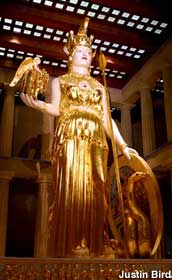
5. Where was a giant statue of Athena kept?

(a) on the steps, where the public could view her
(b) behind the first row of columns, just before the temple entrance
(c) in a walled room inside the temple

6. Who were depicted on the outer edge of Athena's shield?

7. Of what was the Parthenon chiefly constructed?

8. Of what material were Athena's face, neck, hands, arms and feet constructed?

9. What was remarkable about Athena's drapery, aside from the fact that it was made of pure gold?

10. When was the parthenon completed?

ANSWERS

1. In Athens, on the Acropolis.

2. Pallas Athene, primary protector of Athens and the Attic country.

3. (c) Corinthian, Ionic and Doric

4. It is said there were portraits of Phidias (chief sculptor) and Perikles (Athenian statesman) carved on Athena's sandal, which later caused some outrage as this was considered impious.

5. (c)

6. Amazons

7. Pierian marble

8. ivory

9. It was removable

10. 438 BC, by the architects Iktinos and Kallikrates after the Persians destroyed the older Athena temple.


Novel word count: 11, 321

Sunday, April 15, 2007

Assyriana, starring George Clooney


Well not really, but otherwise it might not have that much glamour...at first.

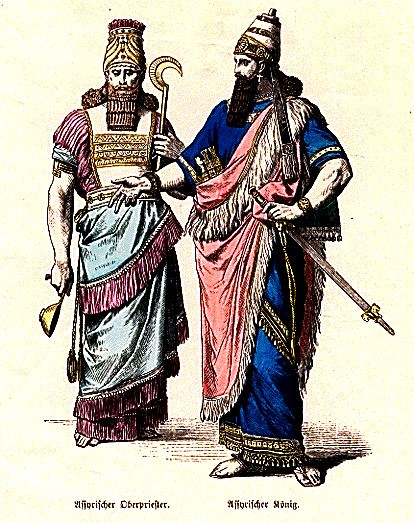
On closer inspection the Assyrians are pretty durned fascinating -- bad-ass, curly-bearded dudes in embroidered dresses.
Assyria, or 'Ashur', as they knew it, incorporated parts of modern Iraq, Syria and Turkey. They were so proud of their unspeakably horrible war crimes that they made huge stone tablets (steles) detailing the inventive tortures (hooking lips, lopping hands and other members....). Not only that, they had a reputation for oppressing women (keep in mind that this was the ANCIENT WORLD, folks! Your man-on-the-street was an opinionated thug who kept his womenfolk locked in a dark room). The king kept a harem of women attended by eunuchs, and all the princes were castrated to keep them from spoiling the regal brood.

But do not think that they were mere thugs! No. For lo, apparently they invented many systems still used today. Locks! Flush toilets! The post! Plus they wore those cool pointy-toed shoes that curl up at the ends. And they crafted some amazing jewellery, like an elaborate golden crown featuring the distinctive winged-bull figure.

A queen's jewellery was found in a tomb, along with a stone tablet inscribed with a curse severely admonishing potential grave-robbers.

They even had their own alphabet and epic, Gilgamesh, which I now desperately want to read. What's more, they have left boastful inscriptions with interesting details such as scorpions and death-penalty procedures.

Yay for the cold-blooded killers! May they rest in peace.

Sunday, April 8, 2007

Ajax

Ajax
by Sophocles.

Scene: (Greek camp outside Troy)

Plot Summary:
One night Ajax is gripped by a psychotic delusion and kills the army's sheep and cows believing them to his hated allies in the Greek army.
The next day he comes to his senses and, despite his wife and half-brother's pleas, he commits suicide in contrition: "Henceforward I shall know to yield to the gods,/And teach myself to respect the Atridae [Menelaus and Agamemnon]".

When his body is found, there ensues a heated argument between Teucer, Ajax's brother, and Agamemnon. Teucer sues for the right to bury Ajax with the proper rites; Agamemnon declares that Ajax should be denied such rites because he tried to kill the Greeks.
In the end Odysseus speaks to Agamemnon as a friend and persuades him to allow the burial to go ahead.

Review:
Antigone has the same kind of plot and is a more interesting play in my opinion.

Wednesday, April 4, 2007

Union Benefits

Here's a poem from a great book, Greek Lyric Poetry trans. Sherod Santos. Norton (2005 NY)

The Tomb of Theris

Here lies a man who made his living off well-
marked traps, who rode the breakers like a gull --

marauder of fishes, hauler of seines, prober
in the crannies of rock and cliff -- who never

once sailed the crowded lanes in an open-
rigged, long-beaked quinquereme, who scorned

the gods by dying not in the bloodbath
of a battle, nor shipwrecked in the aftermath

of a hurricane, nor in any way fishermen
normally end. He died, instead, of his own

accord, dimming out like the evening light
on a cot in his wood-plank hut. No wife,

no children arranged for his burial,
but the members of the local fishermen's guild.

Leonidas of Tarentum


PS Having proper burial arrangements was extremely important to the ancient Greeks, in fact it was one of the main benefits of having children. In Argonautika Jason's mother begs him to stay with her because, "I'd forgotten my troubles/so that you with your own hands might have interred me,/my child; that alone was what I had left to hope for/ from you; with all other returns for nurture I'm surfeited."

Monday, April 2, 2007

Name that Plague!

I've been wondering what diseases afflicted the ancient Greeks, and in particular whether they suffered from smallpox (by the way, if you want to see some truly horrifying examples of that disease, try Google images).*

I know nothing about microbiotic forensics, but this seems a complicated question to answer. I've come across some fairly interesting stuff. For example, this from http://ancienthistory.about.com/od/epidemics/g/Kerameikos.htm:

"Kerameikos [a potter's district in ancient Athens] has an ancient burial pit with bodies from the Peloponnesian War, which Manolis Papagrigorakis, from the University of Athens, has examined. He has determined from DNA in the teeth that the plague that killed perhaps as many as one third of the Athenians was Salmonella enterica serovar Typhi, according to the Discovery Channel, reporting on Papagrigorakis' article in the International Journal of Infectious Diseases." [The article is available online]

Salmonella enterica serovar Typhi is the Latin name for Typhoid Fever. According to Papagrigorakis, "Considering the overcrowding and insanitary conditions (especially regarding water supplies) within the walls of the beseiged Athens, a typhoid epidemic would have been likely to break out either as the solitary cause of the plague or as a minor epidemic adjunct to a yet unidentified agent of the major one."

The symptoms of typhoid fever are as follows:

Symptoms
o Severe headache
o Fever
o Loss of Appetite
o General discomfort, uneasiness, or ill feeling (malaise)
o Rash (rose spots) appearing on the lower chest and abdomen during the second week of the fever
o Abdominal tenderness
o Constipation, then diarrhea
o Bloody stools
o Slow, sluggish, lethargic
o Fatigue
o Weakness
o Nosebleed
o Chills
o Delirium
o Confusion
o Agitation
o Fluctuating mood
o Difficulty paying attention (attention deficit)
o Hallucinations


The presence of typhoid fever in ancient Greece seems to be confirmed by the Founder of Modern Medicine himself, Hippocrates. The following case study of his fits the bill:

Case v. In Thasus, the wife of Dealces, who was lodged upon the Plain, from sorrow was seized with an acute fever, attended with chills. From first to last she wrapped herself up in her bedclothes; still silent, she fumbled, picked, bored, and gathered hairs (from them); tears, and again laughter; no sleep; bowels irritable, but passed nothing; when directed, drank a little; urine thin and scanty; to the touch of the hand the fever was slight; coldness of the extremities. On the ninth, talked much incoherently, and again became composed and silent. On the fourteenth, breathing rare, large, at intervals; and again hurried respiration. On the sixteenth, looseness of the bowels from a stimulant clyster; afterwards she passed her drink, nor could retain anything, for she was completely insensible; skin parched and tense. On the twentieth, much talk, and again became composed; loss of speech; respiration hurried. On the twenty-first she died. Her respiration throughout was rare and large; she was totally insensible; always wrapped up in her bedclothes; either much talk, or completely silent throughout. Phrenitis.


*It is believed that one of the Pharoahs, Ramses V, died of small pox, because of spots on his mummified face.

Sunday, April 1, 2007

Lysistrata

As a way of researching ancient Greek life, I've been compiling a list of common nouns mentioned in classical literature.

Here are some interesting ones:

leopard

midwife beetle (followed pregnant eagles to steal the eggs)

omlette

watchdog

Persian Steel

Victoria Public Art Gallery is hosting an exhibition of Persian steel.

It's not ancient Greece (where steel had not even been discovered) but Persia 15th century onwards offers some interesting insights into an older lifestyle, which I might scavenge for ideas about the ancient world.

Here are some of the objects (many of them ornate and decorated with 'watered steel' -- where the steel is embossed with acid):

inkscoops, penholders, penboxes
armour (chainmail, armpit 'mirrors')
scissors
falcon stands
decorative padlocks (one was shaped like a bear had ruby eyes and emerald teeth)
armband boxes for tiny Qu'rans
jeweller's tools
silver mirrors
tweezers
hand-held balances (for use at bazaars)
daggers
butcher's cleavers
sugar cutters moulded to look like Englishmen naked except for top hats.

John was most excited by the multi-tool -- an early version of the Swiss army knife!

In the foyer leading to the exhibition, two other things caught my eye

1) instruments used by ancient Chinese morticians. These were two leaf-like 'eye-covers' made of jade, earplugs, noseplugs, stone batons called pigs, which were put into the corpse's hands, and an 'annular plug'. Eww.

2) a block embossed with coin moulds -- apparently the Chinese metalsmith poured molten bronze on the block, the excess flowed off and what was left was the milk-token shaped coin.

Tuesday, March 27, 2007

Argonautika

I'm reading the story of Jason and the Golden Fleece, as told by Apollonius Rhodios (who lived on Rhodes) and translated by Peter Green.

Apollonius Rhodios is a great storyteller fits action, war, gods, monsters, ill-fated love and gods in the space of four books. He also provides a vivid picture of what ancient life was like. For example, he provides a detailed description of the practical process of embarking on a sea journey...

1. dig out a track for the boat to the water
2. get the prow onto a polished treetrunk, which will be the first of several 'rollers'
3. lash the oars to the boat's benches so the handles are sticking out. Push on the handles in unison so the rollers carry the boat to the sea
4. stow the gear (sails, clothes, arms, livestock)
5. conduct a sacrificial ceremony on the shore to Apollo of Embarkations. This involves building an altar of pebbles, killing a couple of oxen, praying, wrapping the butchered thighs in fat and burning them as an offering to the god, pouring wine on the offering (libation), and having a diviner interpret the signs.
6. have a big feast with what's left of the oxen. Tell stories until everyone is obnoxiously drunk, then listen to music
7. get up in the morning and head off.

Monday, March 26, 2007

Story Outline

I have an idea for a book.

A remote village in Asia Minor is raided and destroyed, leaving a sole survivor-- a youth of about eighteen. Bereft of his tribe, he heads south, towards Arabia, planning to exact revenge.

On the way he joins a Phoenician merchant vessel and becomes involved in trade, travelling to many different corners of the Mediterranean world including the Bosporus, Memphis, Carthage, Syracuse, Crete and Athens.

The book will include a violent pirate raid, a pitched battle, a religious festival [sacrifice, singing, women], a market scene [slavery, philosophers] , a love affair, a wedding, and a reunion and one or more hospitality scenes.

I am planning to smuggle in details about dogs, jewellery, cloth, disease, ship gear, scenery (animals, plants, weather, geography), philosophy, speech, contrast between aristocratic life and rural and urban poverty.

Friday, March 23, 2007

Girl in the Meadow

At fluting giggles and hymns,
I woke from dark dreams
underneath a quivering oak.

Girls whose sandals and feet
seemed horses and harnesses raced
through the grass, hair flying.

The sun looked down
on pale cherry blossom
when Love approached (her irises gems,

her limbs the whitest) first,
as her mystical servants bent
with willow-wick baskets to harvest

flowers freshly sown by her feet –
a crumb-trail of lily and larkspur.

I wish you had seen Persephone smiling,
the rope of her hair that hung at her nape,
her skewed wreath of roses and robe of light blue,
in her basket a straw and a crocus.

The moment she saw me
I held a red petal up
between her face and the sun.

Thursday, March 22, 2007

nurse's poem

Let go my hand; the purple claw that curls a fist
spreads to clasp my shawl
with writhing motions of that grub-like arm and wrist.
Wear the newborn's caul
and tears your mother just now cried and kissed
to night, your overall.

Saturday, March 10, 2007

Black Gruel, part 4

"Ha ha! Outsmarted you!"
I smiled weakly at him as he headed away to the pantry, but really I was filled with alarm. As soon as he untied the pouch he would discover Draces’s ring, recognise it and deduce that things did not happen exactly as I had described.
If I simply ran away, he would advertise a description of me and I would be a known outlaw for miles around. Aside from complicating my training, this would ruin my reputation at the barracks, because above all we prided ourselves on stealth. I would be a laughingstock, a mere anecdote like that fool Pythos who ended up brained by a flute girl.
The obvious thing for me to do was to kill this guy and I really, really didn’t want to do that. Call me a Persian, but I had no desire to arouse the wrath of the divine Host. This person had extended the courtesies to a stranger whom he believed to be a slave. There are those boys from the barracks who would spit on me for that sentiment, but I say that it was not cowardice but piety and prudence. After all, there is no shame in fearing the gods and if I killed this man, there was a good chance Zeus would punish me for it.
I stayed where I was but I could clearly picture in my mind the man opening the pouch, seeing the ring and planning my destruction.
I stole into the courtyard looking for some object that might serve as a weapon if things came to that. I spied a hoe, and moved myself within arms’ reach. I must have stood there in the courtyard with its little garden and modest fountain for a short time, but it seemed like an epoch. The songbirds looked at me curiously and sang songs about how odd I looked and how I was obviously up to no good. The plants, which were essentially weeds growing from converted troughs, hovered in a breeze from the open door and gleamed maliciously. With every minute, I felt more inclined to race down after the man and get him with the hoe.
Finally, his wood-soles sandals clattered on the cobblestones and he appeared laden with not only my purse (which was now bulging) but also a larger bag full of what looked like flat bread and hollowed gourds full of liquid. If he had discovered my identity as the murderer of his friends, he showed no sign of it. In fact, he was whistling cheerily as he approached and he seemed no longer as loutish. In fact he was standing tall and walking easily, imparting a sense of leisurely confidence.
"Ah, there you are, over there lad."
I eyed him warily.
"Here is your stuff. You won’t want to be hanging around here too long, I’ll bet, though I’ve no objection. Take this. You’ll want to try the black gruel – that’s particularly good stuff. Our specialty; pigs cooked in their own blood it is. Get going now. What are you staring at? Oh, this." He looked down at the ring on his hand. "I hope you don’t mind if I borrow it from you. I always thought it would look good on me. What do you think?"
I nodded and started backing away.
"Don’t worry about anything." He called as I ran out of the door. "It will be our little secret."

Thursday, March 8, 2007

Black Gruel, part 3

"Help!" I yelled.
The burly man stared at me for a bit, then grabbed a switch and jumped into the pigpen, flapping the pigs away from me.
"There you are – get away while you can."
"Thank you," I gasped and dramatically crawled over the fence of the pen.
The pigs were calming down now that I was out, and the lout scratched them behind the ears as you would a dog. I saw him stoop to inspect the wound in the side of one – she had lain down in the mud and was losing much blood. The big man swore and stuck the pig in the throat with a knife that hung from his belt. Meanwhile I gathered my wits and pretended to catch my breath.
I could see that the man was bewildered, and that he kept lifting up his head looking out for his friends.
"Draces!" He yelled. "Alcias!"
He muttered something under his breath, walked easily over the railing and approached me uncertainly. Immediately I adopted the position of a supplicant; bowing low before him and extending my hand towards his knees, which were the size and colour of treetrunks.
"Kind host, I beg you in the name of Zeus protect me from those wild beasts."
He scratched the back of his head.
"What? Wild…?" Then he threw back his head and laughed. "Those piggies? Those babies? Ha ha!"
I affected to tremble, and even managed a couple of tears. He stared at my face in surprise.
"Please, noble husband, I entreat you to save my life from those vagabonds!"
He looked over his right shoulder, then his left.
"Vagabonds? Where?" He narrowed his eyes "Do you mean the other two…a big one and a little one?"
"No, no, you must mean the two brave heroes."
He looked confused.
"I apologize. Let me begin from the beginning. My name is Nautes I am a destitute helot from P, a settlement four miles away. My old master recently died and before he passed he instructed me to offer my service to a man in H-----, to the the east. I was travelling in those woods late last night, looking for a root cavity to curl up in, when I heard crackling sticks behind me and sure enough I was being followed by robbers. Ordinarily I would turn and fight my ground, but these men were monstrous, and there must have been about eight of them."
"Hmmm. They were big then?"
"Huge."
"And were they dark skinned?"
"Yes! Dusky."
"And did they have big noses like, like one of those eagles?"
"Exactly. By Zeus, have you seen them before?"
"No not them exactly but I know the type. That’ll be the Boeotians. There’s a camp of them not far from here and a lot of no good they do."
"Then you know why I was frightened for my life."
"Well, it is not very manly but …not all of us are raised in the barracks, after all. And even if you were it wouldn’t do any good against those dirty bandits."
"I confess that I was frightened and so in need of comfort that I saw your farm with the pigpen and it reminded me of home. It made me think that if I slept here, among the animals, it would keep me warm and that bandits would not dare to attack a stronghold such as yours."
"Very right-thinking of you."
"But I underestimated their underhand brutality and early this morning I woke up and one of them was there." I covered my eyes and pointed in front of me. "His sword was unsheathed and he was smiling so… I was so terrified I could not even squeak, but the pigs knew what to do. They made a run for it and knocked him off balance just as he was going to lunge at me. I fear that that pig suffered the blow that was meant for me. Luckily, just as this happened, two brave, strong men came out of nowhere and gave the bandit second thoughts. Despite his size, he was startled by their ferocity and turned tail."
"So that was Draces and Alcias. Where did they go?"
"They chased him, but I was in shock and had lost my sense of direction thanks to the mist. I tried to follow to lend them a hand, but I could not find my way. It was awful…I heard screams, the clashing of weapons and the sound of flesh being stricken...."
The man frowned with concern.
"A Boeotian. They’ll have their hands full. Zeus and Mars…" The elaborate workings of his mind came to a standstill as he remembered his manners. Clearly he had enjoyed being called a protector, and proceeded to act the part.
"But I am forgetting myself. Please, guest, come in. Have your fill of food and I will provide you with a place to rest until you have recovered from your ordeal."
"Thank you," I sank lower into the ground and touched his rough feet. "May the gods repay you doubly, and may your friends be safe."
The large man awkwardly motioned for me to get up, so I got to my feet and followed him into the house.
"You’ll want to change," he said, scratching his head again. He scratched it so often I wondered if he had fleas. "You can use Alcias’s spare tunic. He won’t mind."
He fetched a coarse, but relatively clean tunic and I put it on, carefully transferring my pouch to my new outfit.
The man looked at it quizzically.
"My supplies," I smiled.
"It is so small for such a long journey! How do you survive?"
"Oh, my master was a skilled hunter and taught me many things."
The man tut-tutted.
"You will have to take more provisions with you. We have a whole storehouse of things – you will take as much as you can carry. And wine, too. Draces is stingy with the wine, but I’ll smuggle some out with you. Please -- sit down and rest while I prepare lunch and fetch your supplies." He put out his hand to take my pouch.
"Why do you stall?"
"It is too kind of you. I cannot accept such generosity when I do not have the means to return it adequately."
"Pish!" It is the gods’ law of welcoming strangers. Hand it over."
"I am too much in your debt already."
He was too quick for me. Like a falcon his arm swooped for the purse and grabbed it away from me. The man laughed triumphantly.

Wednesday, March 7, 2007

Black Gruel, part 2

I forgot about the scratching animals and instead opened a pouch I’d filled with dried food – a sardine, a few figs and a tuber. I didn’t eat it, but just wanted to look at my supplies. Good for about a week. I would have to start relying on my hunting skills. I carefully tied up the material and stowed it in my tunic above the belt.

I sat on the ground for a little while, arms hugging my knees while I thought of what to do next.

I had surveyed the farm for a week now, and ascertained that the farmer was a helot. He was taller than a Spartan, and his movements were more fluid and dance-like. He had two assistants who looked like deformed Greeks – perhaps they had been foundlings.

I’d watched long enough to know that he had a set routine, from which he rarely deviated. At dawn he would rise and toss food to a holding of about seven large pigs, and a few piglets. They would come running, grunting appreciatively, then the farmer would footle about making repairs, tending to a vegetable garden and feeding a mess of chickens.

At lunchtime the whole crew would go inside, probably for lunch and a sleep. Then later on, around sunset, they’d feed the pigs again.

So far I had been very careful not to steal from the garden – I wanted to scope out the area first. It would have been the easiest thing in the world to slip into their garden without leaving footprints and to take a [lettuce/beet]. I refrained because I didn’t want to rouse anyone’s suspicions.

Today I was planning to make my move. My plan was to be as bold as possible, to kill all three farmers under the cover of this mist, then to empty the house of valuable supplies. The house was in such a remote area of the valley that I was tempted to move into the house myself, but I knew that would be unforgivably foolish. Some time or other a visitor or wayfarer would pass and news would spread of my occupation.

My stomach was empty, but I felt my limbs filling with the strength that comes from Mars before any daring venture. My eyes were given greater clarity of vision and I heard the beat of drums in my ears. My fingers tingled with a lust for action and I set off for the direction of the farm, using landmarks I had marked out in my period of surveillance: there was the grove of laurels, there was the pile of old cups, there was the goat carcass – it must have had mange because the skin and silky hair was left on it – and finally I was so close that I could see the black flank of a small pig that was rooting about in a pile of vegetable shavings.

Its eye glinted like a small obsidian bead and I could not tell if it was aware of my presence or not. I had tried to accustom him to my smell and motion by visiting the pig pen in the evenings. If it was aware of me, it didn’t care at all or make any indication of it.

The mist was so thick that I couldn’t see the farmer, though I could tell he was fairly close because he was whistling through his teeth and humming. I moved stealthily around the perimeter of the pigpen and approached the wall of the house, taking care where I put my feet so that I would make no sound.

At last I was within a couple of metres of him, and could make him out. He was about ten years older than me, northern looking, with light brown hair and a tall frame and leathern skin. He had a blade in his hand and was trimming a shrub whose branches were straggling out untidily. I knew that at any moment he would turn around and see me, so it was necessary to get it over with quickly.

I was about to leap out from my hiding place, when one of the Greek servants appeared armed with a club.

"Whar ye going wi’ that club, lad?" Asked the man.
"Oi’m gonna get a lion. Arfes said there are loins ‘round here – ’e ’eard them prowling and growling last night."
"Oh, is that right?" The man said laconically and turned back to his pruning.
"You be careful that the loion doesn’t get you."
"Oi will," said the dope and hobbled bravely along the path. I waited until he’d passed me for the right time to strike and then carelessly stabbed him in the neck, so that he died instantly, with not even a yell of surprise.
Even so, the farmer knew something was wrong because the body made quite a thump when it hit the ground.
"Pires?" The farmer asked, then, sensing something was wrong and perhaps starting to believe the lion story after all, ran towards the bush where I had again ducked. The fool ran right in front of me and I finished him off with the club I’d taken from the first victim.

When I was certain they were both dead I ransacked their clothes and mouths for valuables. Neither of them had any money and they both let off a rank stink involving pigs, manure, sweat and lard. The old man wore a brass ring with the crude signature of a winged man. I didn’t care for it but thought it might serve as a keepsake so I hastily stowed it in my purse.

Now that they were dead, I had the problem of the third man.

I realised that it would be to my advantage to keep him alive to care for the pigs. So for now, I resolved to hide these two bodies and earn the friendship of the survivor. I hastily dragged the farmer’s body to a spot behind the pigpen and a hillock, then I got the other man and piled him on top. It was hard work and by the time I’d finished covering the men with clippings, I was dripping sweat and stained with blood.

Thinking quickly, I leapt into the pigpen and cut the side of one of the sows with my knife. She squealed and snorted, which alarmed the others and suddenly I was in the middle of an ear-splitting cacophany.

Tuesday, March 6, 2007

Black Gruel

Sparta, 520BC

There was dew all over the ground and it had seeped through my bed of dried grass and dampened my tunic, which was already black and grimy with weeks of sweat and dirt.

Thanks to the full moon and the insistent scratching of some small animal, I'd hardly slept . The scratching reminded me of my hunger, but I felt too tired to get up and trap it. A few of the boys I'd trained with could locate a burrow even on an overcast night. They seemed to have charmed ears and feet that could see even the underground, without the light of the sun. They were the boys who had started hunt and fight for food before they could even talk and who now, at fourteen, were expert at all the arts of war and ambush, hunting and tracking.

I must have drifted off to sleep about an hour before dawn. I had dreams of a wolf that mewed like a kitten but that stared at me with the filmy eyes of an eel. I went to stab it with my sword but found that it was covered in gouts of blood already, as if it had been attacked by a lion or another of its own kind. It seemed to want my sympathy, and I reached out to pat it. At that moment the wolf vanished and I was surrounded by my old classmates from the gymnasium -- all glaring at me with hatred and pointing to my dress, which was an absurd purple woman's tunic, and my fingers wore so many golden rings that I could not move my hand.

It was then that I woke. No doubt I had cried out something in my sleep, for in the moment of waking I saw a six or seven crows flutter up into the safety of an oak's top branches.

The sun was obscured by new clouds, and a fine mist bleached the general landscape. The woodland area that had sheltered me since the beginning of my apprenticeship still clung to night's shadows, but the valley meadows glimmered a deathly grey. Although I couldn't see it now, I looked in the direction of a farm I'd scouted yesterday and heard the grunt of pigs being fed.

[to be continued]

Saturday, March 3, 2007

The Cyprian Boy

Athens, The Agora 496 BC

I was standing in the central market waiting for Draces to make his decision so we could go and have some dried fish and figs at my house. He was dithering at the goldsmith’s stall trying to decide what to buy his wife, who had that morning demanded a gift of necklace as payback for some imagined insult. Phyllis was a vixen with a foul temper. Ever since their wedding Draces had been jumpy as a cricket on a field of hot embers.

Draces was sucking in his cheeks, rolling his obols worriedly with his tongue and scratching his unkempt hair. The goldsmith was yawning and scraping dirt from out of his fingernails with a thin wire. That’s when I saw the boy.

He was floating gracefully between a couple of elderly donkeys and a pancake stall. You’d think Polyanax had chiselled him out of marble, but his hair and skin appeared glowing, smooth and soft. He moved like a long-legged fawn. Just the sight of him made me lick my lips.

As I stood there gawking he realised he was being watched because he raised his head, cast me a wary look, and smiled a little. I smiled back, fascinated by the way his cheeks spread with a rose-petal blush. He turned and took a graceful couple of steps before looking back at me, which is when I noticed his intensely blue irises. I had to stop myself from floating after him.

"Lunch is off Draces," I said.
"Mmmm?" Draces had forgotten I was there even. "Oh! Wait. I’ll be quick. I found something. This. No…this." He clutched desperately at a couple of necklaces.
"Say hello to your father from me." I kissed him abruptly and left in pursuit of the boy. He had only disappeared two seconds, but already I was anxious to catch up with him and smuggle him back to my place, keeping him out of every other wealthy citizen's sight. Weaving past the stalls of ceramics, fruits, slaves and spices, I finally caught up to him where he leaned on a rock to remove a pebble from his sandals. As he bent down his tunic lifted at the back to reveal the backs of his thighs, covered with a down of fine blonde hairs.
He heard my feet and straightened up.
"Your sandal has come unstrapped," I said. "Here, let me tie it."
The boy looked quizzically down at me as I leaned to fiddle with the leather. I became almost dizzy at the fragrance of his sweat mixed with a perfume of something like lilies. My fingers lingered achingly on the curve of his anklebone.
"Thank you," he sounded foreign.
"Where are you from?"
"Cyprus."
"Cyprus? Any relation to Aphrodite?"
"Of course; son-in-law. Where are you from?"